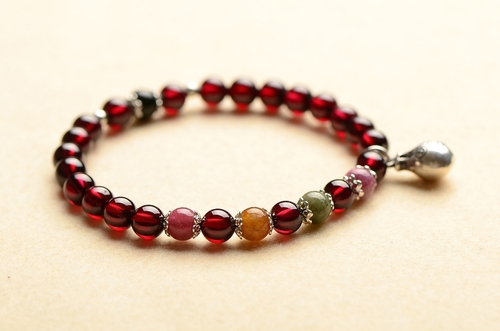
Garnet
Garnet: Pros & Cons of Identification and Valuation — Mounted vs Unmounted
By Karen Howard — Jewellery Appraisers Coach
Garnet has a talent for surprising people. Most jewellery owners think of it as the deep red birthstone of January, inexpensive and common. But in reality, the garnet family includes some of the most fascinating and valuable gems on the market — from vivid tsavorite to colour-change garnet and even rare demantoid with horsetail inclusions.

For appraisers, garnet presents both opportunities and challenges. Identification can be more complex than first glance suggests, and accurate valuation requires confidence in variety, quality and setting considerations. Whether the stone is loose or mounted will change how you approach the work.
Let’s explore the pros and cons.
The Garnet Family — A Quick Refresher
Garnet isn’t a single gemstone. It’s a group containing multiple species and varieties, frequently found in blends. Some well-known examples include:
•Pyrope — typically deep red
•Almandine — darker red to purplish-red
•Spessartine — orange to reddish-orange
•Grossular — green, yellow, colourless, brown
•Tsavorite — bright green grossular variety
•Hessonite — cinnamon orange grossular variety
•Demantoid — highly refractive green andradite garnet
•Rhodolite — pyrope-almandine blend, purplish-red
Different varieties bring dramatically different price points — which is precisely where valuation gets interesting.

Identifying Garnet: Pros & Cons
Pros
✔ Readily identifiable properties
Refractive index, specific gravity, and absorption spectra are generally reliable indicators when the stone is unmounted. However, some properties are off the capabilities of some instruments,
✔ Inclusion patterns can help
For example, chrysotile “horsetail” inclusions are strongly associated with demantoid, adding both value and confidence.
✔ Minimal enhancement concerns
Garnet is rarely treated, making valuation more straightforward once identification is secure.
Cons
✘ Extensive overlap
Many garnets sit between species. This can complicate identification without advanced instruments.
✘ Wide range of colours and appearances
Rhodolite vs pyrope? Grossular vs hessonite? Andradite vs demantoid? It’s easy to mis-classify.
✘ Mounted identification limits
When a stone is set, refractive index, birefringence, and SG testing may be restricted or impossible, increasing uncertainty.
Valuing Garnet: Pros & Cons
Pros
✔ Strong market demand for premium varieties
Tsavorite and demantoid can command high values, especially with excellent colour and clarity.
✔ Good stability and durability
With a hardness between 6.5–7.5, garnet generally withstands wear and protects value over time.
✔ Attractive to collectors
Unusual colours (mint, purple, colour-change) increase desirability.
Cons
✘ Huge price variation
Low-value red almandine vs high-value tsavorite — you must know exactly what you’re looking at.
✘ Mounted stones hide clarity and cutting issues
Inclusions, chips, windowing and weight estimation become harder to assess in metal.
✘ Limited pricing data
There are fewer structured market comparables compared to diamonds or sapphires. Research time increases.

Mounted Garnet — Special Considerations
Pros
•Preserves the stone’s condition
•Shows intended colour and brilliance in natural presentation
•May provide age, origin and authenticity clues based on mounting style
Cons
•Restricted access limits testing
•Accurate weight estimation becomes essential
•Valuation may depend more heavily on reportable assumptions and disclaimers
•Risk of misidentification increases
For premium greens and collector stones, you may advise the client that removal is required — or refer to a trusted gem lab.
Unmounted Garnet — Special Considerations
Pros
•Clearer visibility for inclusions, cut quality and colour zoning
•Full access to refractometer, hydrostatic SG testing, UV response and filters
•Weight certainty increases valuation confidence
Cons
•Loose stones may have chips or abrasions
•Easy to mix up varieties if unlabelled
•Market for loose garnet is more variable than mounted retail
Unmounted gems give you better science; mounted gems give you better context. Both matter.
The Appraiser’s Advice to Clients
When clients ask about value, here are simple guidelines:
1️⃣ Not all garnet is created equal
The variety, colour, clarity and cut matter enormously.
2️⃣ Certificates may be worthwhile
Especially for tsavorite and demantoid.
3️⃣ Condition counts
Wear, chips, abrasions and durability influence value.
4️⃣ Market demand fluctuates
Rhodolite is strong at retail, tsavorite performs well at auction, hessonite and spessartine depend on quality.
5️⃣ Mounted vs loose changes the process
Set expectations that testing, and value ranges may differ.

Final Thoughts
Garnet is one of the most rewarding gems to appraise — when you know what you’re looking at. With varieties ranging from everyday jewellery to museum-quality collector stones, correct identification is the foundation of correct valuation.
Whether the stone is loose or mounted, the appraiser’s role remains the same: apply science, maintain curiosity, protect the client, and stay aware of market reality.
And above all — never underestimate garnet.
